Neck Stiffness Exercises That Actually Help
A stiff neck rarely starts as a dramatic injury. More often, it builds quietly after long hours at a laptop, tense commutes, poor sleep position, stress, or a workout that left the shoulders overworked. The right neck stiffness exercises can help, but only when they match the reason your neck feels tight in the first place.
That distinction matters. Some people need gentle mobility. Others need to calm irritated tissues before stretching at all. And many people with recurring neck tension are actually dealing with a combined problem involving the upper back, shoulders, jaw, breathing pattern, or posture at work. If exercises help for a day and the stiffness keeps coming back, the neck is often not working alone.
When neck stiffness exercises are useful
Neck stiffness exercises are usually most helpful when the problem is mechanical. That means the neck feels tight, restricted, or achy because of muscle tension, joint restriction, desk posture, stress loading, or minor strain. In these cases, gentle movement often improves circulation, reduces guarding, and helps normal motion return.
They are less useful when the neck is highly inflamed, acutely injured, or irritated by a condition that needs medical assessment first. If moving your neck causes sharp pain, tingling into the arm, marked weakness, dizziness, severe headache, fever, or pain after trauma, exercises should not be your first step.
For everyday stiffness, though, the goal is usually not to force a stretch. It is to reintroduce calm, comfortable motion. That is a very different approach from pushing through pain.
Start with less intensity than you think
One of the most common mistakes is stretching too aggressively. People feel tight, so they pull hard on the head or hold a stretch for too long. That can make a protective neck tighten even more.
A better starting point is controlled movement with light effort. Think of the nervous system first, then the muscles. If the area feels safer, range of motion often improves naturally.
1. Chin nods for deep neck support
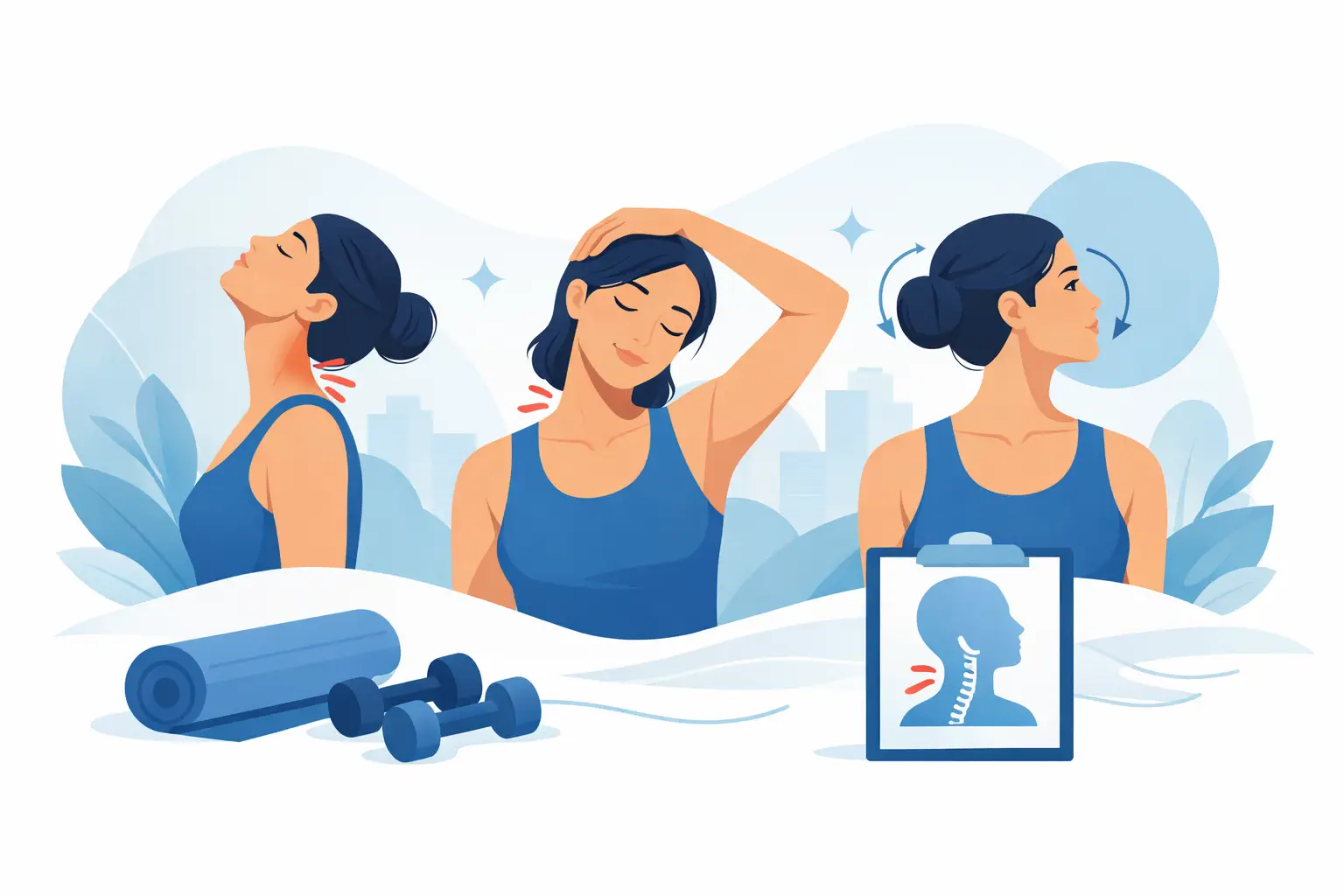
Sit upright with your shoulders relaxed. Gently draw your chin straight back as if making a subtle double chin, then release. This is not a forceful tuck and not a downward bend. The movement is small.
Repeat 8 to 10 times with easy breathing. You should feel the back of the neck lengthen slightly. This exercise can help people who spend long hours looking slightly forward at a screen, which often overloads the upper neck.
2. Slow neck rotation
Turn your head slowly to one side only as far as comfortable, pause for a breath, then return to center and repeat on the other side. Keep the jaw loose and the shoulders quiet.
Try 6 to 8 repetitions per side. If one direction feels much more restricted, do not force it. Asymmetry often points to combined stiffness in the upper cervical spine, upper trapezius, levator scapulae, or upper thoracic region.
3. Side bending with minimal effort
Tilt one ear toward the same-side shoulder, then return to center. Repeat to the other side. The important point is to avoid lifting the shoulder to meet the ear.
This movement is often enough on its own. You do not need to add hand pressure unless the movement is pain-free and still feels easy after several days.
4. Shoulder rolls and scapular reset
Many stiff necks are really overworked shoulders. Roll both shoulders up, back, and down in a smooth circle 8 to 10 times, then reverse direction. After that, gently draw the shoulder blades back and down for 3 to 5 seconds, then relax.
This helps reduce the constant upward pull that keeps the neck muscles braced. It is especially useful after computer work, phone use, or travel.
The upper back often needs attention too
If the thoracic spine is rigid, the neck usually compensates. That is why neck stiffness exercises work better when they are paired with upper-back mobility.
5. Seated thoracic extension
Sit on a chair with a supportive back that reaches the middle of your shoulder blades. Place your hands behind your head for support, gently lift your chest, and lean backward over the chair without throwing the head back.
Repeat 6 to 8 times. The movement should feel broad through the upper back, not pinchy in the lower neck. For many desk workers, this is the missing piece.
6. Open-book rotation
Lie on your side with hips and knees bent. Reach both arms straight in front of you, then slowly open the top arm across the body, rotating the chest while the knees stay stacked. Follow the hand with your eyes if comfortable.
Perform 5 to 8 repetitions on each side. This can reduce the rotational demand placed on the neck during daily movement.
Gentle stretches can help – if timed well
Stretching has a place, but not always at the beginning. If the neck is very reactive, movement first is often better. Once symptoms settle, light stretches can help maintain length in tissues that have been overworking.
The upper trapezius stretch is familiar but often overdone. Sit on one hand to keep the shoulder down, tilt the opposite ear slightly away, and hold 15 to 20 seconds. The sensation should be mild, not intense.
For the levator scapulae, turn your head about 45 degrees, then look slightly down toward the armpit. A light hand on the back of the head can increase the stretch a little, but only if there is no pain. Hold 15 to 20 seconds and repeat 2 to 3 times.
These stretches are best used after heat, after a shower, or after the mobility exercises above. Cold, guarded muscles rarely respond well to strong stretching.
What to avoid when your neck feels stiff
A few habits tend to slow progress. Fast neck circles are a common one. They can compress already irritated joints and are rarely necessary. Forceful self-cracking is another. It may give temporary relief, but it often does not address why the area keeps tightening.
It also helps to avoid doing all your exercises in one big session and then staying still for the next ten hours. For office workers, two or three minutes of gentle movement repeated through the day is usually more effective than one long session at night.
Pain is also useful information. Mild stretching discomfort can be acceptable. Sharp pain, radiating symptoms, nausea, dizziness, or increasing headache are not signs to push through.
Why stiffness keeps returning
Recurring neck tension usually means there is more than one contributor. Screen height, laptop work, poor sleep support, jaw clenching, shallow breathing, gym technique, and stress can all keep the neck overloaded.
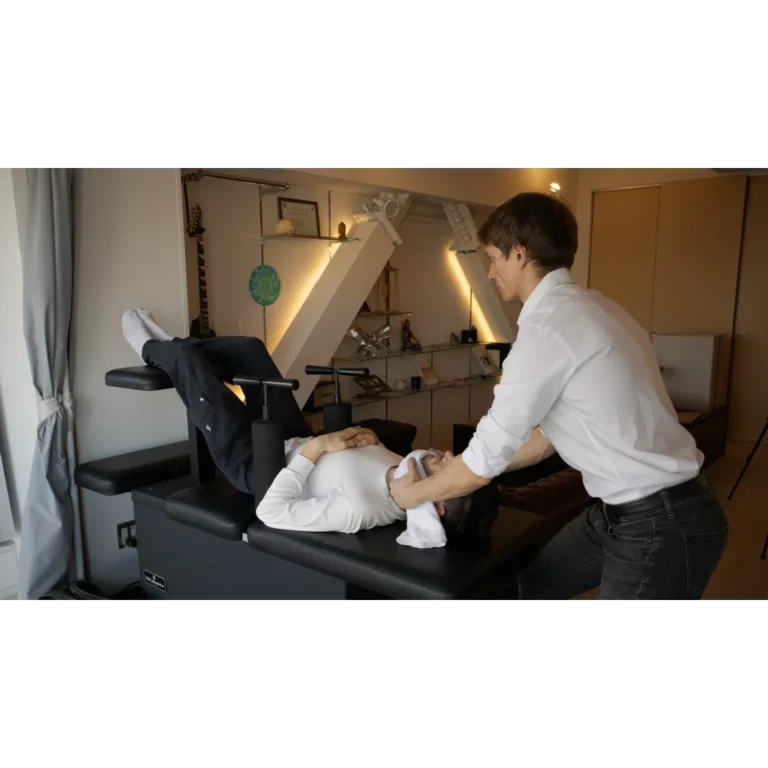
This is why a purely exercise-based approach sometimes gives partial relief but not lasting change. If the rib cage is stiff, the shoulders are elevated, or the jaw is overactive, the neck keeps compensating. In practice, this is often where a hands-on assessment becomes valuable. A more complete treatment plan may include manual therapy, work on the upper back and rib mechanics, advice on workstation setup, and specific exercises that fit your pattern rather than generic stretches from the internet.
At Osteopath Tokyo, this whole-body view is central to care. The neck is assessed in relation to posture, breathing, shoulder mechanics, stress tension, and daily habits so treatment is targeted, comfortable, and practical for real life in Tokyo.
When to seek professional care
If neck stiffness lasts more than one to two weeks, keeps recurring, or starts affecting sleep, concentration, training, or work, it is worth having it evaluated. The same is true if you are getting associated headaches, jaw tension, shoulder pain, or symptoms into the arm.
Professional care is particularly useful when you are unsure what is driving the problem. A pregnant patient, for example, may need a different approach from a tennis player, a new parent carrying an infant, or an executive spending twelve hours a day on a laptop. The best exercises depend on the context.
A careful osteopathic assessment can also help distinguish between a neck that needs mobility, a neck that needs stability, and a neck that first needs irritated tissues to calm down. Those are not the same thing, and treating them as if they are often leads to frustration.
A simple routine to begin with
If your symptoms are mild and clearly related to posture or tension, start with chin nods, slow neck rotation, side bending, and shoulder rolls once or twice a day. Add thoracic extension if you sit for long periods. Keep the movements comfortable, steady, and easy to repeat.
If you feel looser afterward, that is a good sign. If you feel more guarded later the same day, reduce the range, effort, or number of repetitions. Good neck stiffness exercises should leave the area calmer, not more irritated.
The most effective plan is rarely the most aggressive one. A neck that has been bracing for days or weeks usually responds best to precise, gentle input and a clear understanding of why it tightened up in the first place. Sometimes a few simple movements are enough. Sometimes the body is asking for a more individualized solution.