Ebisu, Tokyo · Yokosuka
Full body adjustment + Ring Dinger®
Spinal decompression along the Y-axis
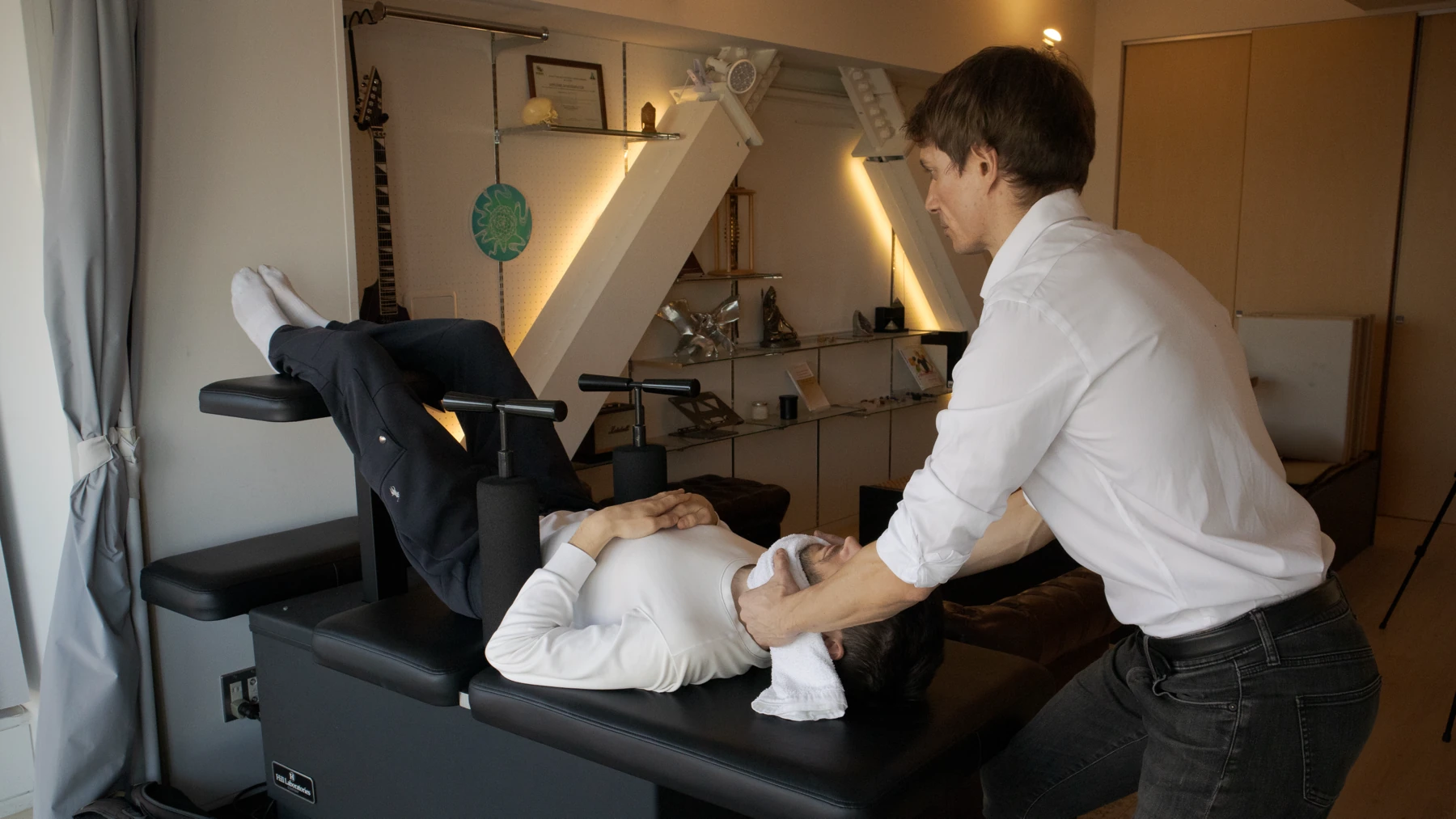
A short, focused session. David works through the whole spine, then finishes with one controlled decompression along the long axis of your body — the technique known as the Ring Dinger®. It is quick, it is specific, and it is not for everyone, which is why every session begins with checking that it suits you.
Session
30 minutes · screening included
Price
¥18,000, or ¥15,000 with the three-session package
Consultations in
English, 日本語, français
What is the Ring Dinger®?
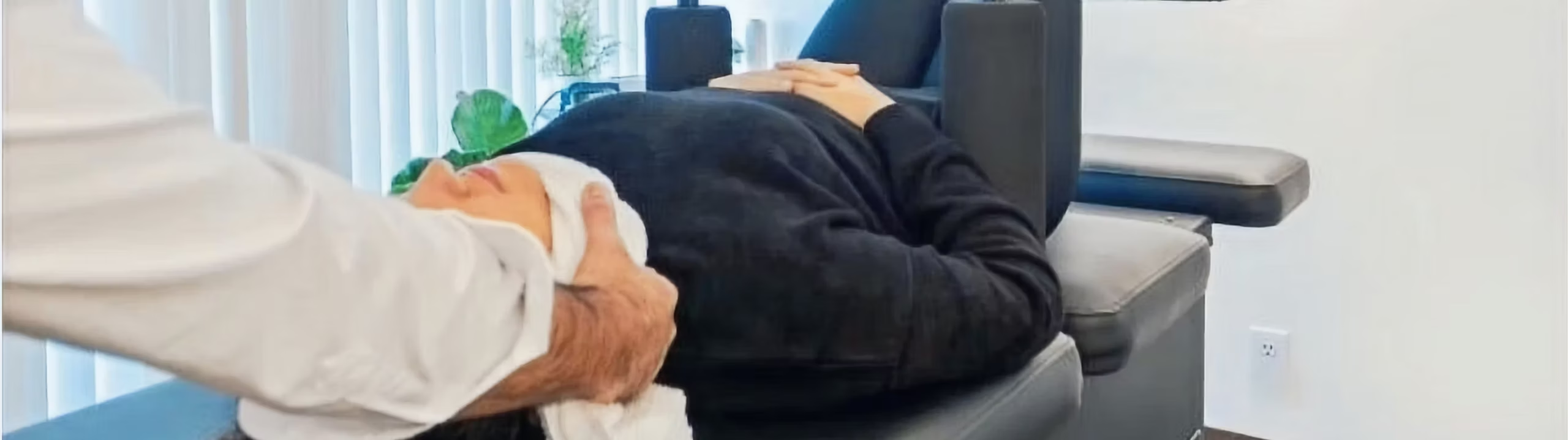
The Ring Dinger®, also known as the Johnson Y-Axis Adjustment™, is a manual decompression technique. You lie on your back, your hips and legs are secured, and a fast, controlled traction is applied along the long axis of the body — the Y-axis. Rather than adjusting one segment at a time, it takes the spine lengthwise, in a single movement that lasts a fraction of a second.
The sound people associate with it is cavitation — gas coming out of solution inside the spinal joints as the pressure in them drops. It is the same phenomenon as any joint releasing. It is not bone moving, and it is not a measure of how well the technique worked: a quiet adjustment can be just as effective as a loud one.
What happens in the session
Step 1
Screening
David goes through your history, your symptoms and anything you already know from scans or a diagnosis, and checks for what would rule the technique out.
Step 2
Full-body adjustment
Soft tissue work and joint adjustment come first, neck to pelvis. Tissue that has already been loosened responds better, and the decompression is far more comfortable that way.
Step 3
The decompression
You are secured at the hips and legs, David tells you exactly when it is coming, and the traction is applied. Most people find it far less dramatic than the videos suggest.
Step 4
Afterwards
Most people stand up feeling taller and looser. A day of mild soreness, like the day after training, is normal. David tells you what to expect and whether you need to come back at all.
The question everyone asks
Is it safe?
It looks dramatic on video, and that is most of where the worry comes from. The technique itself is a controlled traction, performed by David and no one else, and the usual after-effect is a day of mild soreness.
The safety sits in the screening rather than in the pull. David will not perform it if you have thinning bone or osteoporosis, a recent fracture, spinal surgery or spinal implants, inflammatory disease of the spine, a bleeding disorder or anticoagulant treatment, a known vascular condition, or cancer affecting bone — and not during pregnancy.
If anything in your history is unclear, he will say so and treat you with the holistic osteopathy session instead, which reaches much of the same ground more gradually. Being told no is a normal outcome of the screening, not a wasted visit.
What people come in for
Results vary from person to person, and nobody can promise you an outcome. These are the patterns that respond best.
Feeling compressed
Long days at a desk, long commutes, heavy training, heavy lifting. The end-of-week feeling of being shorter and tighter than you started — the sensation the technique is aimed at.
Mechanical back and neck pain
Pain and stiffness that change with position, movement or time of day, and that have been checked out as mechanical rather than something needing medical treatment.
Nerve-pattern symptoms
Sciatica, referred pain and tingling, where the picture points to pressure on a nerve. Symptoms that are spreading or worsening need medical assessment before any adjustment.
Which session should you book?
This one
Book the full body adjustment + Ring Dinger® if you already know this technique and came for it specifically, or if you have had it before and want it again.
It is a focused half hour: screening, a full-body adjustment, the decompression, and what to do next. It is not a full assessment of why the problem started.
Holistic osteopathy
Better for a first visit, for a problem nobody has explained to you yet, during pregnancy, for children, or whenever you are simply not sure.
The hour buys a full assessment and a wider range of techniques — and David can still include a full-body adjustment where it is appropriate. More on holistic osteopathy.
Please note
This treatment is not a substitute for urgent medical care. If you have severe or sudden symptoms, please seek medical advice promptly. David is an osteopath: he works with his hands only, helping the body rebalance and draw on its own capacity to heal. He makes a functional diagnosis, not a medical one, and he does not prescribe or carry out medical procedures such as surgery. If something needs a doctor, he will say so.
What patients say



Book a full body adjustment + Ring Dinger®
¥18,000 per session, or ¥15,000 per session with the three-session package. Choose your clinic below.
Ebisu, Tokyo
Monday – Thursday & Saturday
Full body adjustment + Ring Dinger®
Screening, full-body adjustment and the decompression, in the Ebisu treatment room, a short walk from Ebisu Station.
Yokosuka
Fridays
Full body adjustment + Ring Dinger®
The same session, on a Friday. Second floor, stairs only.
Not sure the Ring Dinger® is for you?
Tell David what is going on and he will say honestly whether this is the right session for you, or whether something gentler would serve you better — in English, Japanese or French.